Nervous System Basics Explained:
A Clear Guide to How Your Body Communicates
MIND AND BODY
1/14/20266 min read
Nervous System Basics Explained: A Clear Guide to How Your Body Communicates
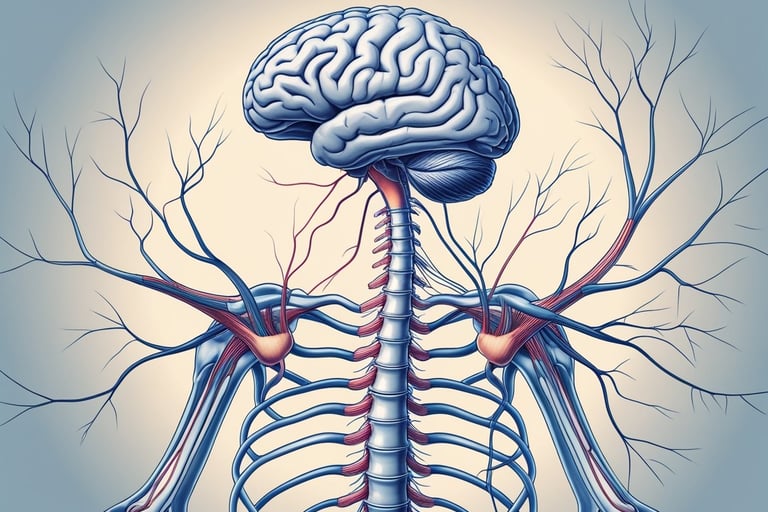
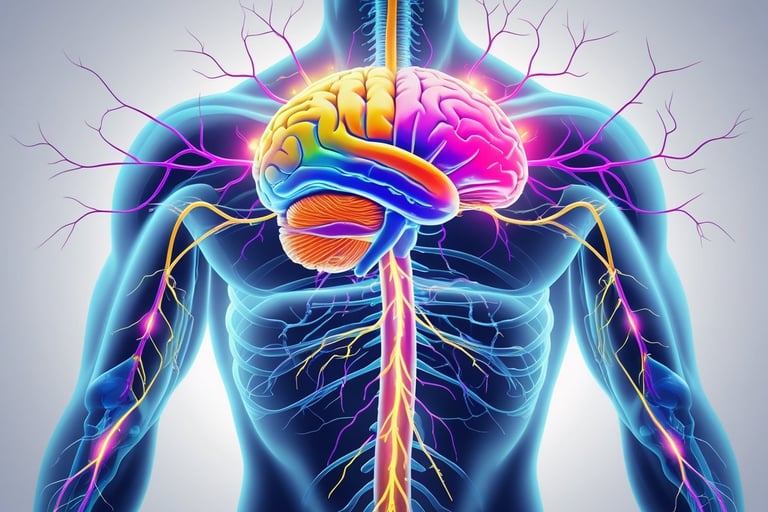
Your nervous system serves as your body's command center, controlling everything from breathing and movement to thought and sensation. This complex network of your brain, spinal cord, and nerves works by sending electrical signals that coordinate all bodily functions and responses to your environment. Understanding how this system operates reveals the foundation of human physiology and health.
The nervous system consists of two main divisions that work together seamlessly. The central nervous system includes your brain and spinal cord, while the peripheral nervous system encompasses all the nerves extending throughout your body. These components communicate through specialized cells called neurons, which transmit signals at remarkable speeds to keep your body functioning properly.
Your nervous system processes information from your sensory organs, coordinates muscle movements, regulates internal functions like heart rate and digestion, and enables you to think and respond to the world around you. Learning the basics of this system helps you understand how your body maintains balance, reacts to danger, and performs countless automatic tasks without conscious effort.
Key Takeaways
Your nervous system functions as your body's communication network, using electrical signals to control all physical and mental processes
The system divides into central components (brain and spinal cord) and peripheral nerves that extend throughout your body
Specialized neurons transmit rapid signals that coordinate everything from automatic functions to conscious movements and thoughts
Nervous System Fundamentals
The nervous system operates through specialized cells and tissues organized into two major divisions that work together to detect stimuli, process information, and coordinate responses throughout your body via electrical and chemical signals.
Basic Structure and Divisions
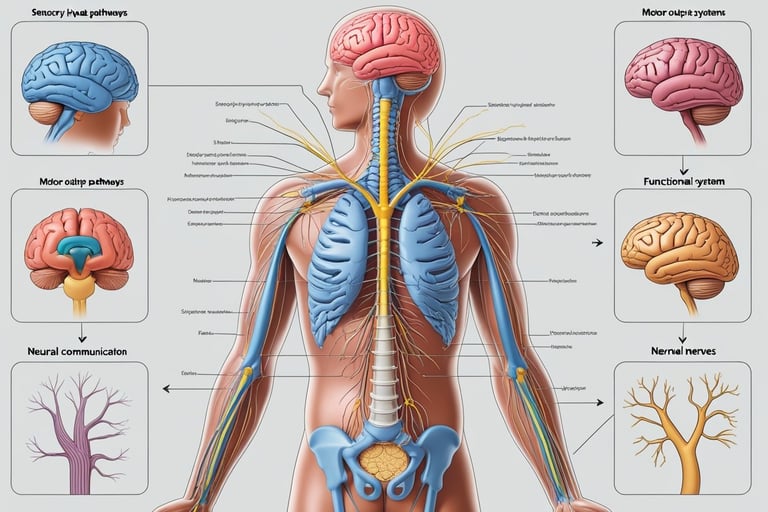
Your nervous system divides into two main anatomical parts: the central nervous system (CNS) and the peripheral nervous system (PNS). The CNS consists of your brain and spinal cord, which serve as the primary processing centers for all neural information. Your brain interprets sensory data, generates thoughts, stores memories, and controls voluntary movements. Your spinal cord acts as the main pathway for signals traveling between your brain and the rest of your body.
The PNS includes all nerves and nervous tissue outside the CNS. These nerves extend throughout your body, connecting your CNS to your muscles, organs, and sensory receptors. The PNS has two functional subdivisions: the somatic nervous system controls voluntary movements and processes sensory information, while the autonomic nervous system regulates involuntary functions like heart rate and digestion.
Motor nerves carry commands from your CNS to your muscles and glands. Sensory nerves transmit information from your sensory receptors to your CNS for processing.
Key Functions of the Nervous System
Your nervous system performs three fundamental functions: sensation, integration, and response. Sensation involves detecting stimuli from both your external environment and internal body through specialized sensory receptors. These receptors convert physical stimuli into electrical signals your nervous system can process.
Integration occurs primarily in your CNS, where your brain and spinal cord analyze incoming sensory information. This processing determines appropriate responses based on current conditions, past experiences, and biological needs. Your nervous system continuously integrates multiple sources of information simultaneously.
Response is the output phase where your nervous system sends commands to effectors like muscles and glands. These electrical impulses travel through motor nerves to produce actions ranging from voluntary movements to automatic reflexes. Reflexes represent rapid responses that bypass conscious processing, allowing your body to react quickly to potential threats or maintain essential functions without conscious effort.
Types of Nerve Cells
Your nervous system contains two main cell categories: neurons and glial cells. Neurons are the functional units that generate and transmit electrical signals. Each neuron has three basic parts: dendrites that receive signals, a cell body containing the nucleus, and an axon that transmits signals to other cells.
Your nervous system contains three types of neurons based on function:
Sensory neurons carry information from sensory receptors to your CNS
Motor neurons transmit commands from your CNS to muscles and glands
Interneurons connect neurons within your CNS and process information between sensory input and motor output
Glial cells outnumber neurons and provide essential support functions. Astrocytes maintain the chemical environment around neurons and help form the blood-brain barrier. Oligodendrocytes produce myelin in your CNS, while Schwann cells create myelin sheaths around peripheral nerve fibers. This myelin sheath acts as insulation, dramatically increasing signal transmission speed along axons. Microglia function as immune cells, protecting your nervous tissue from pathogens and removing cellular debris. Ependymal cells line fluid-filled spaces in your brain and spinal cord.
White matter consists of myelinated axons, while gray matter contains neuron cell bodies, dendrites, and unmyelinated axons.
How Signals Are Transmitted
Your neurons communicate through electrical and chemical signals. An action potential is an electrical impulse that travels along an axon when a neuron is sufficiently stimulated. This nerve impulse moves as a wave of electrical charge created by ions moving across the neuron's membrane. In myelinated nerve fibers, the action potential jumps between gaps in the myelin sheath, accelerating transmission.
When an electrical signal reaches the axon terminal, it cannot directly jump to the next cell. Instead, the signal must cross a synapse, the tiny gap between neurons. At the synapse, the electrical signal triggers the release of neurotransmitters, chemical messengers stored in small vesicles. These neurotransmitters cross the synaptic gap and bind to receptors on the receiving neuron's dendrites.
This binding can either excite the receiving neuron, making it more likely to fire its own action potential, or inhibit it. Your brain processes information through complex patterns of excitation and inhibition across billions of synapses, enabling everything from basic reflexes to complex thoughts.
Core Components and Functional Systems
The nervous system divides into the central nervous system (brain and spinal cord) and the peripheral nervous system (cranial and spinal nerves), with each system performing distinct roles in processing information and coordinating body functions through specialized neural pathways and communication networks.
Central Nervous System: Brain and Spinal Cord
The central nervous system consists of your brain and spinal cord, protected by the meninges and the vertebral column. Your brain serves as the primary control center, containing approximately 86 billion neurons that process sensory information and coordinate responses.
The cerebrum forms the largest part of your brain, divided into two hemispheres covered by the cerebral cortex. This outer layer handles your cognitive function, learning, memory, and emotion. Your right hemisphere typically processes spatial awareness and creativity, while specialized regions like the insula process taste and internal body sensations.
The brainstem connects your brain to the spinal cord and includes the midbrain, pons, and medulla oblongata. These structures regulate your heartbeat, breathing, digestion, and swallowing automatically. The cerebellum coordinates your movement and balance, while the thalamus relays sensory information to appropriate brain regions.
Deep brain structures include the hypothalamus, which maintains homeostasis and links your nervous system to the endocrine system by controlling hormone release. The hippocampus processes memory formation, and various ganglia clusters help regulate motor control.
Your spinal cord extends from the brainstem through the vertebral column, transmitting signals between your brain and body. It contains both sensory and motor pathways organized into white matter tracts and gray matter processing centers.
Peripheral Nervous System: Connections and Roles
Your peripheral nervous system encompasses all neural tissue outside the brain and spinal cord, including 12 pairs of cranial nerves and 31 pairs of spinal nerves. These nerves form the physical connections between your central nervous system and the rest of your body.
The peripheral nervous system divides into somatic and autonomic components. Your somatic nervous system controls voluntary movement through motor neurons and transmits sensory information from sensory receptors in your skin, muscles, and sensory organs. These sensory neurons detect touch, vision, and other senses, sending signals to your brain for processing.
The autonomic nervous system regulates involuntary functions through three subdivisions:
Sympathetic nervous system: Prepares your body for stress responses
Parasympathetic nervous system: Promotes rest and recovery functions
Enteric nervous system: Controls digestive system operations independently
Motor nerves carry commands from your central nervous system to muscles and glands, while sensory nerves transmit information from sensory receptors throughout your body. Ganglia located outside the central nervous system serve as relay stations for these neural pathways.
Communication and Coordination in the Body
Your nervous system maintains communication through electrical signals that travel along neurons at speeds up to 120 meters per second. Sensory neurons detect stimuli from your environment and internal body states, converting physical and chemical signals into electrical impulses.
The connectivity between neurons, sometimes called the connectome, creates complex networks that enable your cognitive function, emotion regulation, and motor control. Neural plasticity allows these connections to strengthen, weaken, or reorganize based on your experiences and learning.
Your brain processes sensory information from multiple senses simultaneously, integrating touch, vision, taste, and other inputs to create coherent perceptions. The thalamus acts as a relay station, directing sensory signals to appropriate cortical regions for interpretation.
Coordination between your nervous and endocrine systems maintains homeostasis through feedback loops. Your hypothalamus monitors internal conditions and triggers hormonal responses when adjustments are needed. Motor neurons execute precise movements by coordinating muscle contractions, while the cerebellum refines these actions for smooth, accurate motion.

The Healthyish Protocol
Stay connected and follow us on social media for the latest updates!
Express your ideas or propose a topic.
© 2024. All rights reserved.