The Minimum Effective Dose of Sleep
How Much Rest You Really Need to Perform and Thrive
FOUNDATIONS
1/26/20264 min read
The Minimum Effective Dose of Sleep: How Much Rest You Really Need to Perform and Thrive
You don't need to chase a one-size-fits-all number to get useful, restorative sleep. Your minimum effective dose of sleep is the smallest nightly amount that leaves you alert, focused, and functioning well the next day — and for most adults this often falls around seven hours, but it can be slightly less or more depending on your biology and lifestyle.
Start thinking of sleep like a personalized prescription: you track how you feel, adjust timing and duration, and settle on the lowest amount that preserves your mood, performance, and health. This post will show how to identify that amount, what signals to watch for, and simple tests you can use to tailor sleep to your life.
Key Takeaways
Find the smallest nightly sleep duration that keeps your daytime alertness and performance stable.
Use daily symptoms and simple tracking to determine if your sleep amount is sufficient.
Adjust sleep time based on personal factors like stress, activity, and long-term health needs.
Understanding the Minimum Effective Dose of Sleep
You can balance sleep duration and quality to support daytime performance, reduce the harms of sleep deprivation, and track progress with objective and subjective tools. Key drivers include your age, health, recent sleep history, and how well your sleep cycles restore cognition and physical function.
Defining Minimum Effective Dose for Sleep
The minimum effective dose of sleep is the smallest nightly sleep duration that reliably lets you meet daytime goals: alertness, memory consolidation, mood stability, and physical recovery. Think of it as the cutoff where performance and safety stop declining for you personally.
To find it, measure outcomes, not just hours. Use sleep tracking (actigraphy or validated consumer devices) plus a sleep diary to record reaction time, mood, and subjective sleepiness across several weeks. Aim for consistency: one or two nights of good sleep won’t establish your minimum.
Start from recommended ranges—typically 7–9 hours for most adults—and reduce in small steps (15–30 minutes) while monitoring function. If cognitive tests, work performance, or mood worsen, you’ve gone below your minimum effective dose.
Physiological Factors Impacting Sleep Needs
Your age strongly alters minimum needs: adolescents require more sleep; older adults often need slightly less but maintain similar restorative processes. Medical conditions—sleep apnea, depression, chronic pain—raise the amount of sleep needed to function normally.
Prior sleep debt magnifies need. After several nights of restriction, you’ll require extra sleep (sleep extension) to restore cognitive and metabolic function. Circadian timing matters too: sleeping at optimal biological night increases restorative quality for a given duration.
Genetics and individual variability affect resilience to short sleep. Some people metabolically tolerate less sleep but most will show measurable performance decline with chronic restriction. Track physiological signals—daytime sleepiness, reaction time lapses, and mood—to judge adequacy.
Sleep Quantity Versus Sleep Quality
Hours matter, but sleep architecture and continuity determine restoration. Deep slow-wave sleep and REM contribute differently: slow-wave supports physical recovery and memory consolidation; REM supports emotional regulation and procedural memory.
Poor sleep quality—fragmentation, frequent awakenings, or misaligned circadian timing—can make long durations ineffective. Use sleep diaries to note perceived continuity and trackers to identify fragmentation or low slow-wave proportion.
Optimize both: maintain a regular schedule, dark cool bedroom, and limit caffeine late in the day. When quantity and quality both improve, you’ll see better daytime performance and reduced need for compensatory sleep.
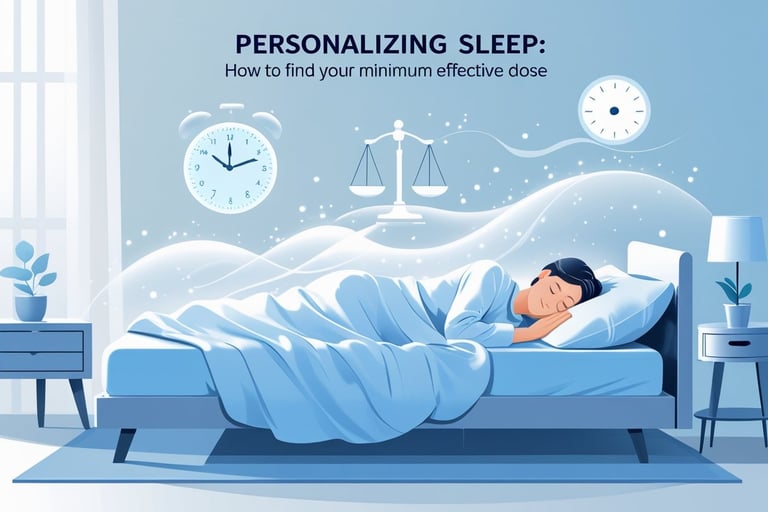
Personalizing Sleep: How to Find Your Minimum Effective Dose
Identify the smallest amount of sleep that leaves you alert, productive, and physically recovered. Track timing, quality, and daytime function to adjust your plan.
Recognizing Individual Sleep Requirements
Everyone’s sleep need varies by age, genetics, and health. Start by keeping a 2–4 week sleep log: record bedtimes, wake times, naps, nighttime awakenings, caffeine and alcohol use, and how you feel mid-afternoon. Use a simple scale (0–10) for daytime sleepiness and cognitive sharpness to judge functional recovery rather than clock hours alone.
Look for consistent patterns. If you wake naturally after 6.5 hours and feel energetic for a full day, that may be your minimum effective dose. If you rely on stimulants, experience memory lapses, or need naps, you likely need more sleep or higher-quality sleep—investigate sleep disorders like sleep apnea or insomnia with a sleep specialist.
Include objective measures when possible. Consumer trackers, heart rate variability trends, or polysomnography for complex cases help confirm whether you’re getting enough deep sleep and completing typical sleep cycles.
Influence of Circadian Rhythm and Sleep Patterns
Align your schedule with your circadian rhythm to get more restorative sleep in fewer hours. Regularize your sleep schedule—same bedtime and wake time—even on weekends. That stabilizes melatonin release and reduces trouble falling asleep and nighttime awakenings.
Identify your chronotype (early bird vs. night owl) and shift timing gradually—15–30 minutes every few days—so you fall asleep more easily and spend adequate time in deep sleep when the body is primed. For jet lag or shift work, use timed light exposure and, if appropriate, short-term melatonin (start low, 0.5–1 mg) to re-entrain timing; consult a sleep medicine physician before medicating.
Watch for fragmented sleep patterns. Recurrent awakenings or reduced slow-wave sleep can mimic short sleep effects even if total hours seem adequate. If you suspect a sleep disorder or persistent insomnia, consider CBT‑I or evaluation for sleep apnea.
The Role of Sleep Hygiene and Environment
Optimize your sleep environment to increase sleep efficiency and reduce the hours you need. Keep the bedroom cool, dark, and quiet; use blackout curtains and white noise if needed. Reserve the bed for sleep and sex only—avoid working or screen time in bed to strengthen the bed–sleep association.
Practice pre-sleep routines: dim lights 60–90 minutes before bed, avoid heavy meals and intense exercise within two hours of bedtime, and limit caffeine after early afternoon. Use targeted strategies to improve deep sleep: regular daytime physical activity, balanced nutrition (avoid late high-sugar meals), and manage alcohol intake.
If behavioral changes don’t help, explore evidence-based treatments. CBT‑I addresses trouble falling asleep and nighttime awakenings. For medication, melatonin supplements or prescription options like trazodone may be considered under a sleep medicine physician’s guidance, typically as short-term aids while you build behavioral sleep improvements.

The Healthyish Protocol
Stay connected and follow us on social media for the latest updates!
Express your ideas or propose a topic.
© 2024. All rights reserved.